
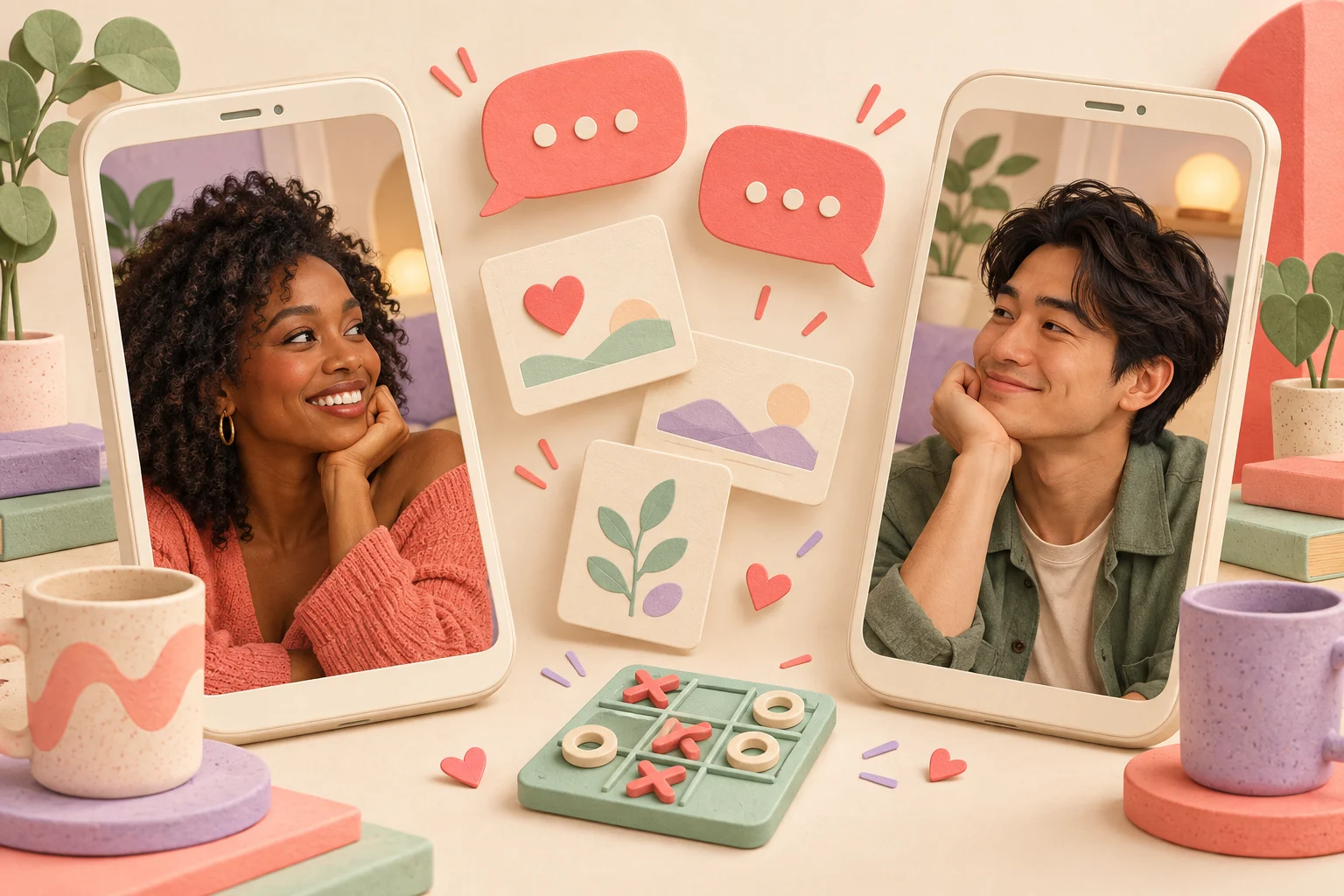
A first video date does not need to be a performance. You are trying to discover whether you enjoy talking to one person, not demonstrate that you would be a perfect partner for everyone.
A little preparation can remove practical distractions. A little curiosity gives you somewhere to go when the opening hello is over. This is an editorial guide to trying both, with room to adapt the suggestions to your own personality.
Set up for comfort, not a production
Place your phone somewhere stable and check that you can hear clearly. Choose lighting that lets the other person see you without making you uncomfortable. Close anything you would not want appearing in a notification or being read in the background.
You do not need a spotless room or an elaborate backdrop. A comfortable seat and a manageable amount of privacy are enough. Avoid displaying an address, workplace documents or other information you have not chosen to share.
If the connection is poor, say so. A frozen screen is a technical problem, not evidence that either person is awkward.
Give the beginning a little shape
An opening such as “I have been looking forward to hearing the story behind that photo” offers a more specific direction than asking for a full life history.
Try one of these, changing the words so they sound like you:
- “What has been the best part of your week so far?”
- “You mentioned cooking. What is the dish you would confidently make for someone?”
- “What is something you are looking forward to this month?”
- “Shall we each pick one question and see where it takes us?”
Avoid reciting a list. Choose one opening, listen to the answer, and let the next question come from something they actually said.
Use the answer, not just the next question
Suppose they say they spent Sunday in a bookshop. You could ask what they found, whether they went looking for something specific, or which book they would recommend. You could also share your own habit of buying books faster than you read them.
The aim is an exchange. Offer something about yourself rather than putting the other person through a sequence of prompts. If they give a short answer, it is fine to change the subject. You do not have to extract a story from every question.
Keep a small activity in reserve
A quick drawing challenge, a round of tic-tac-toe or a conversation card can give you a shared focus. Ask first: “Want to try a quick game?” Leave it optional.
The activity is a reason to interact, not a compatibility test. Losing a round does not tell you whether someone will be a good partner. If you are already enjoying the conversation, you do not need to interrupt it to use a feature.
On VIBSI, cards and quick games are part of the experience. Use them when they help you talk, and skip them when they do not.
Let a pause be a pause
A short silence is allowed. Take a sip of water, think about the answer, or say “I am deciding which story to tell you.” You do not need to apologise every time the conversation slows down.
If you feel you are doing all the work, try a direct invitation: “What would you like to know about me?” Their response can help you decide whether you want to continue. It is information about this interaction, not a verdict on your attractiveness.
Finish with something clear and kind
If you enjoyed the conversation, say so specifically: “I liked hearing about your travels. I would like to talk again.” You can suggest a next step without assuming they want it too.
If you do not want another conversation, keep the ending courteous and avoid promising to message if you do not intend to. You can simply thank them for the chat.
A call ending because its time is up does not itself mean rejection. If there is mutual interest, decide together what happens next. You are also free to leave sooner if you feel uncomfortable.
Your short pre-call checklist
- My camera and microphone work.
- My background does not reveal information I want to keep private.
- I have one question I am curious about.
- I am willing to share an answer of my own.
- I can finish politely without committing to another date.
If you decide to meet offline, choose a public setting that suits you both and make your own travel arrangements. For some flexible options, see our low-pressure first-date ideas.
The useful outcome is clarity: perhaps you want another conversation, perhaps you do not. Either way, you have learned more than a perfectly edited opening message could tell you.
Created with AI assistance and editorial source checks. Practical suggestions reflect editorial judgement, not guaranteed dating outcomes. How we work.